Description of Physical Models
21cmFAST supports many physical models and effects that can often be toggled on or
off interchangeably (though some depend on others). The
MatterOptions and
AstroOptions classes contain all of the flags
that control which models to include in the simulation.
Below we provide a brief explanation on how some of the flags modify the output of
21cmFAST.
Models of the Matter Field
The parameters and flags of MatterOptions
are used to control how cosmological matter fields (e.g. densities, velocities and halo
properties) are evaluated in the simulation.
Source Model
Note
Set with the SOURCE_MODEL parameter of MatterOptions.
To be filled.
Astrophysical Models
The parameters and flags of AstroOptions
are used to control how astrophysical quantities (e.g. star formation rate, UV and
ionizing radiation) are evaluated in the simulation.
It is important to stress that the generation of
PerturbedField and
HaloCatalog objects do not depend on these
parameters (nor on AstroParams). Therefore, if
the cache contains PerturbedField and
HaloCatalog objects that had been previously
generated with a different set of AstroOptions, these objects will
be loaded from the cache, instead of being re-evaluated.
This architecture allows one to quickly simulate different astrophysical models, given a
cosmological model.
Spin Temperature Fluctuations
To be filled.
Minihalos
To be filled.
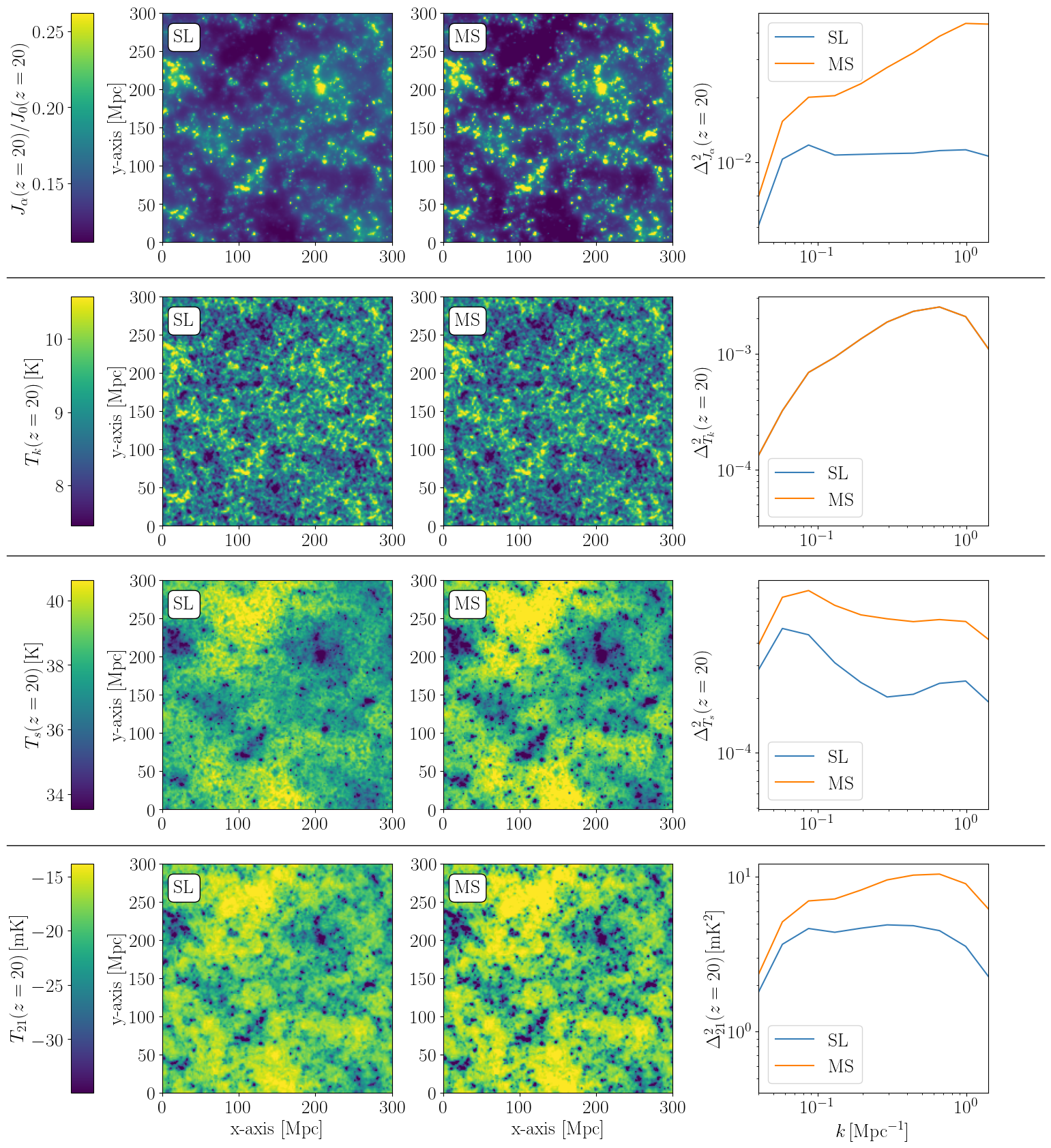
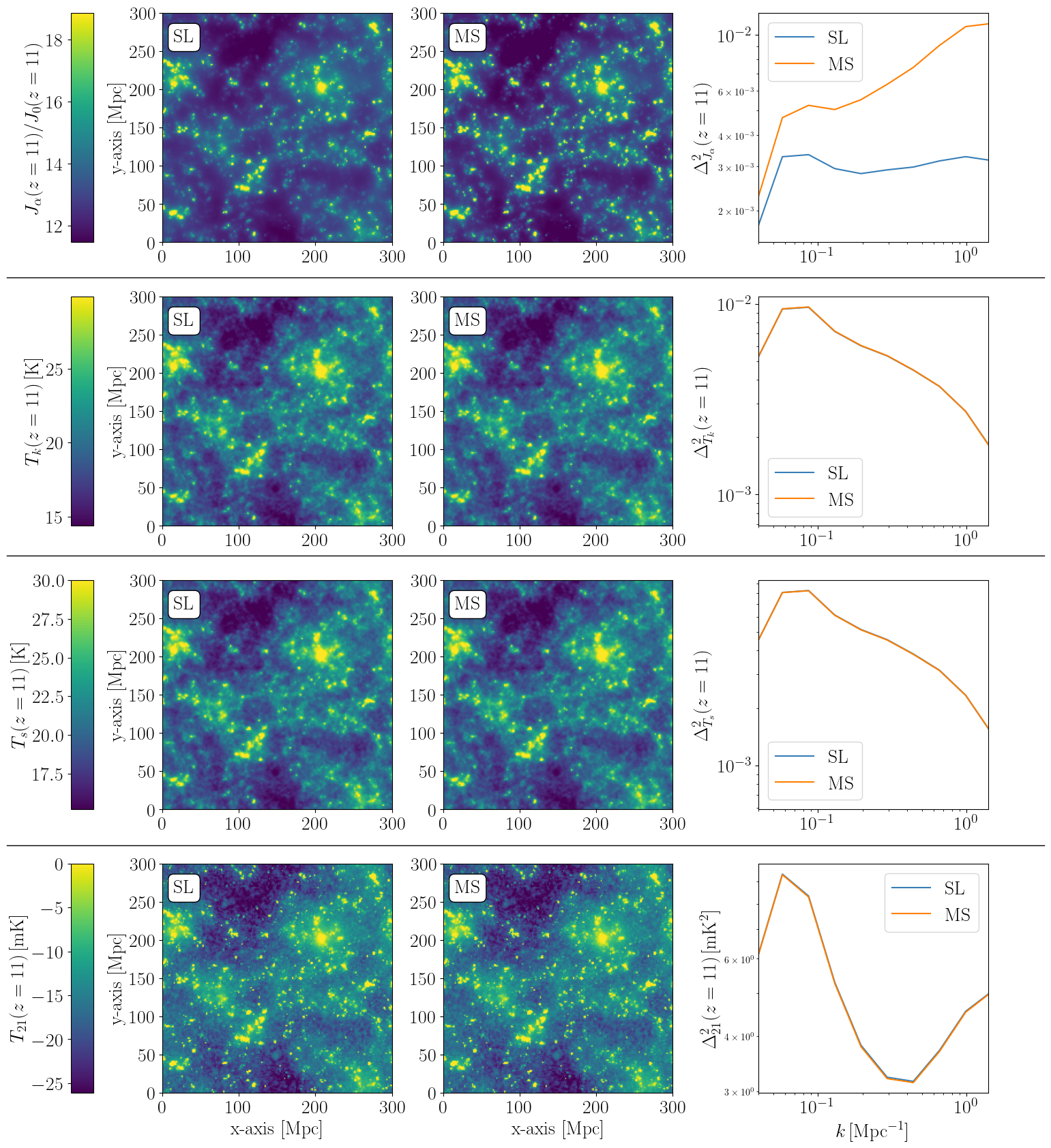
Multiple Scattering of Lyman Alpha Photons
Note
Toggled with the LYA_MULTIPLE_SCATTERING flag of
AstroOptions (default: False).
The physical effect that enables the absorption feature in the 21-cm signal during
cosmic dawn is the strong coupling between the spin temperature and the gas kinetic
temperature. This coupling is obtained through Lyman alpha radiation that comes from the
first stars and is absorbed by the IGM. Since the cross section for the interaction
between photons near the Lyman alpha resonance frequency and HI atoms in the IGM has a
non-negligible width, the Lyman alpha photons that are absorbed by the IGM had not
traveled in straight lines, but rather had scattered along their path. This means that
the effective Lyman alpha emissivity that the IGM “sees” becomes more local, thereby
increasing the contrast in J_alpha (Lyman alpha flux) maps in the simulation, as can
be seen below. In the context of the 21-cm signal, this effect becomes negligible at
sufficiently low redshifts (normally below \(z<15\)), once the spin temperature
completely follows gas kinetic temperature. For more information on this effect in the
simulation, see Flitter, Munoz and Mesinger 2026.