Performance
The runtime of 21cmFAST depends on several sensitivity parameters. These include:
HII_DIMandDIM. The higher these values, the more cells there are in the simulated box, namely more calculations are performed per redshift iteration.Z_HEAT_MAX. The higher this parameter, the simulation begins from a higher redshift.ZPRIME_STEP_FACTOR. The closer this parameter to 1, the more redshift iterations there are. Together withZ_HEAT_MAX(and the minimum redshift of the simulation), these parameters determine the number of redshift iterations in the simulations.N_STEP_TS. The higher this parameter, the more shells are evaluated in the computation of the radiation fields (e.g. Ly $\alpha$ flux, necessary for the evaluation of the spin temperature).R_BUBBLE_MAX,R_BUBBLE_MINandDELTA_R_HII_FACTOR. These three parameters (together with box and cell dimensions) determine the number of ionized bubble radii to consider in the excursion-set algorithm.N_THREADS. The higher this number, the more cpus (threads) participate in the calculation.
Roughly speaking, the total amount of time of the 2LPT calculation in 21cmFAST scales like DIM^3 * N_z / N_THREADS, where N_z is the number of redshift iterations. The total amount of time for the calculation of the spin temperature scales like HII_DIM^3 * N_z * N_R / N_THREADS, where N_R is N_STEP_TS. A similar formula can be used to crudely estimate the total amount of time that is needed for the reionization computations, though here N_R refers to the number of ionized bubble radii.
The total runtime is also affected by the flag and parameter configurations, e.g. whether there are discrete halos in the simulation, and whether mini-halos are taken into account.
Coeval runtime performance
To be filled.
Lightcone runtime performance
To be filled.
Global evolution runtime performance
The following plots were obtained by running 21cmFAST on a Macbook Pro with a processor of 2.3 GHz 8-Core Intel Core i9.
The default parameter values that were considered were N_THREADS=1, Z_HEAT_MAX=35 and ZPRIME_STEP_FACTOR=1.02.
Note that the runtime of the global evolution does not depend on HII_DIM nor on DIM as we have in that simulation only one cell!
The script to make these plots can be found here.
N_THREADS
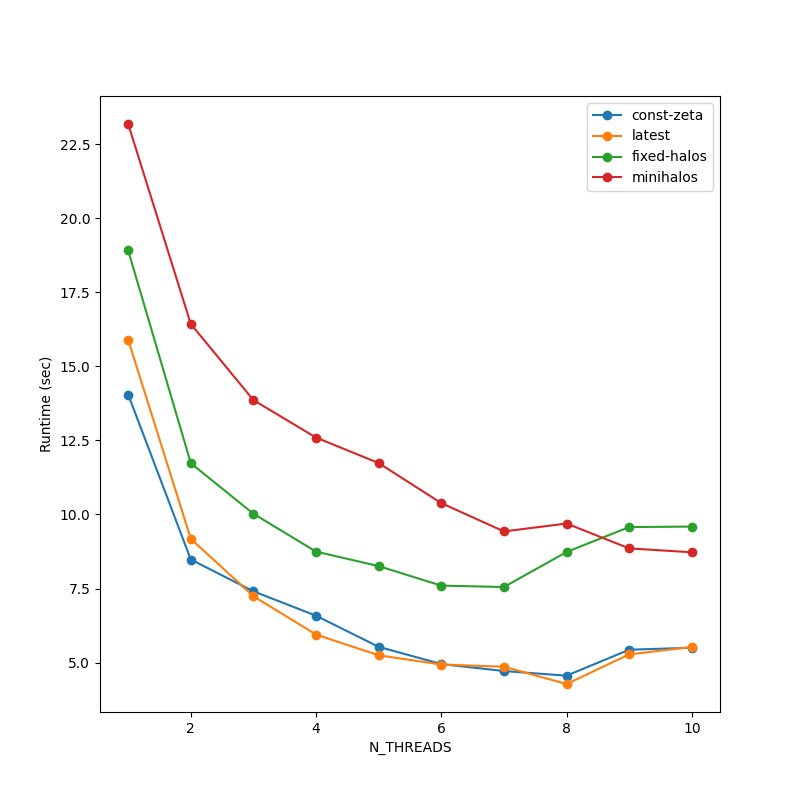
Higher N_THREADS tends to lower the total runtime. Interestingly, this trend exists even though we use
only one cell in the simulation. The reason for this is because multiprocessing is also used in the evaluation of the shells in the computation
of the spin temperature.
Z_HEAT_MAX and ZPRIME_STEP_FACTOR
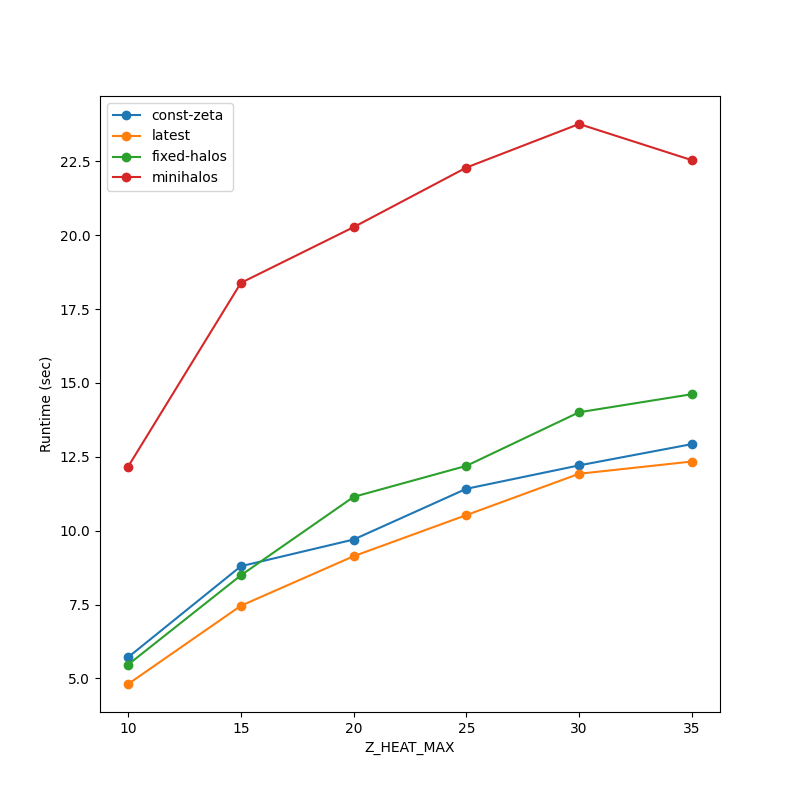
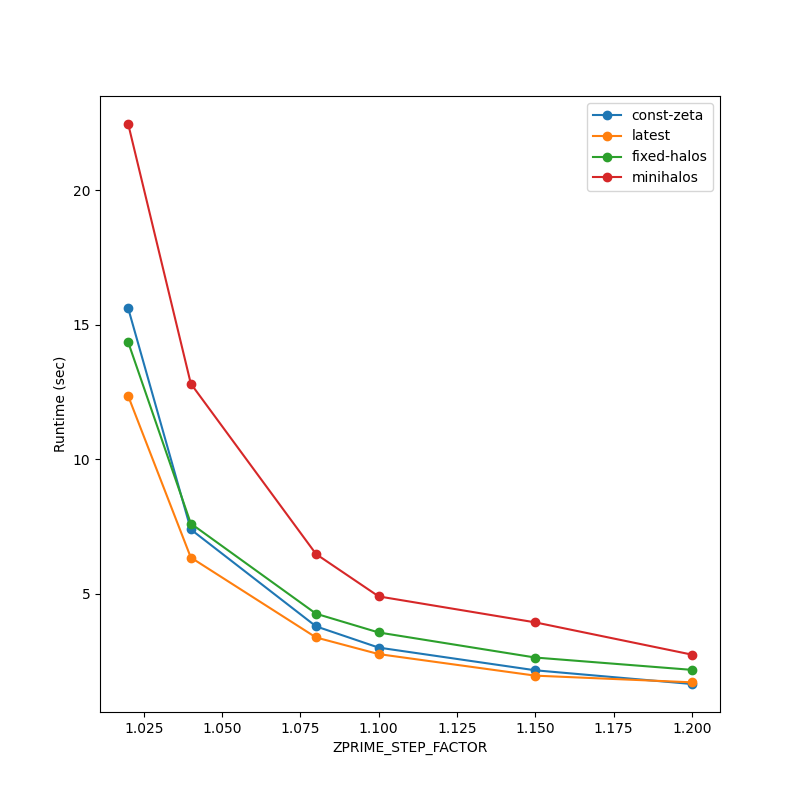
As expected, we can see that higher Z_HEAT_MAX and lower ZPRIME_STEP_FACTOR tend to increase the total runtime (the more redshift iterations
the more time needed for the simulation to complete).